Introduction
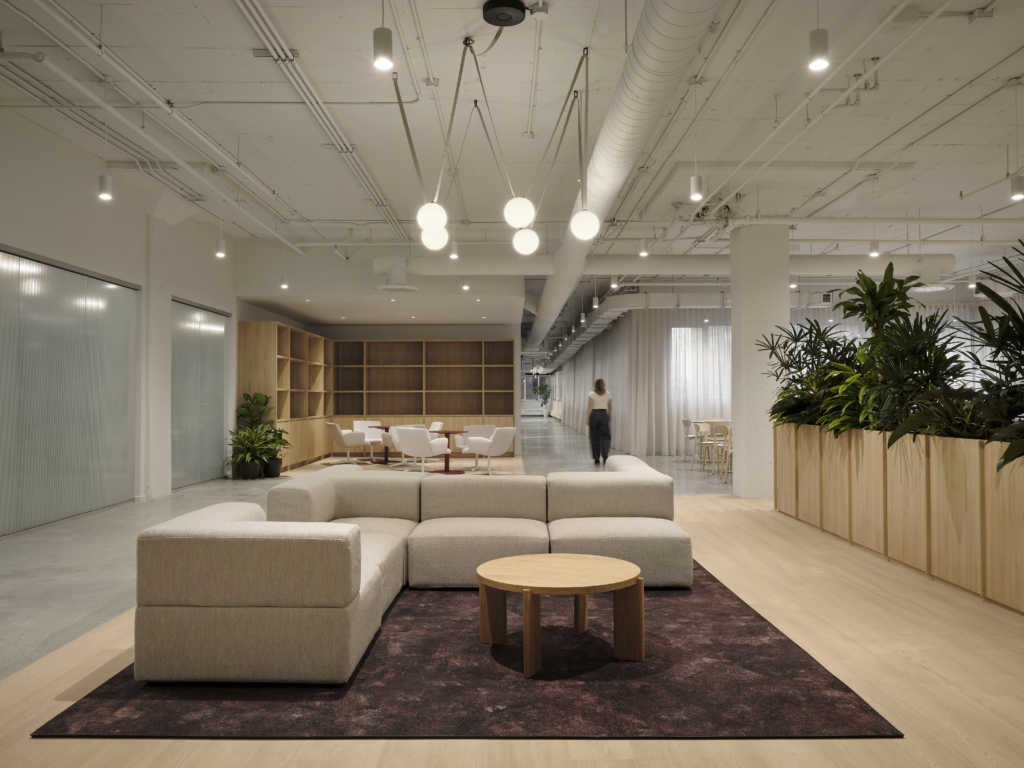
The workspace is no longer simply a matter of aesthetics. It sends a strong signal both internally and externally, and directly influences engagement, cultural cohesion, and performance. In a context where attracting, engaging, and retaining talent is becoming increasingly difficult, the office is taking on a strategic role.
Today, designing high-performing offices requires a nuanced understanding of several layers: the company, the teams, the individuals, work habits, sensory sensitivities, and evolving practices. The goal is not to create a uniform space, but rather an environment that truly supports daily work.
Why Office Design Is a Strategic Issue
Disengagement at work has significant consequences worldwide. The figures mentioned in the source speak for themselves:
– a nearly 20% drop in productivity;
– a 23% decrease in profitability.
Behind these figures lies a simple observation: a less engaged employee produces less, collaborates less, and is less involved in the company’s mission. The workspace therefore plays a key role in how teams are motivated.
Good office design isn’t just about aesthetics. It supports:
- concentration;
- collaboration;
- creativity;
- information flow;
- a sense of belonging;
- autonomy;
- well-being
Start with the Company’s DNA
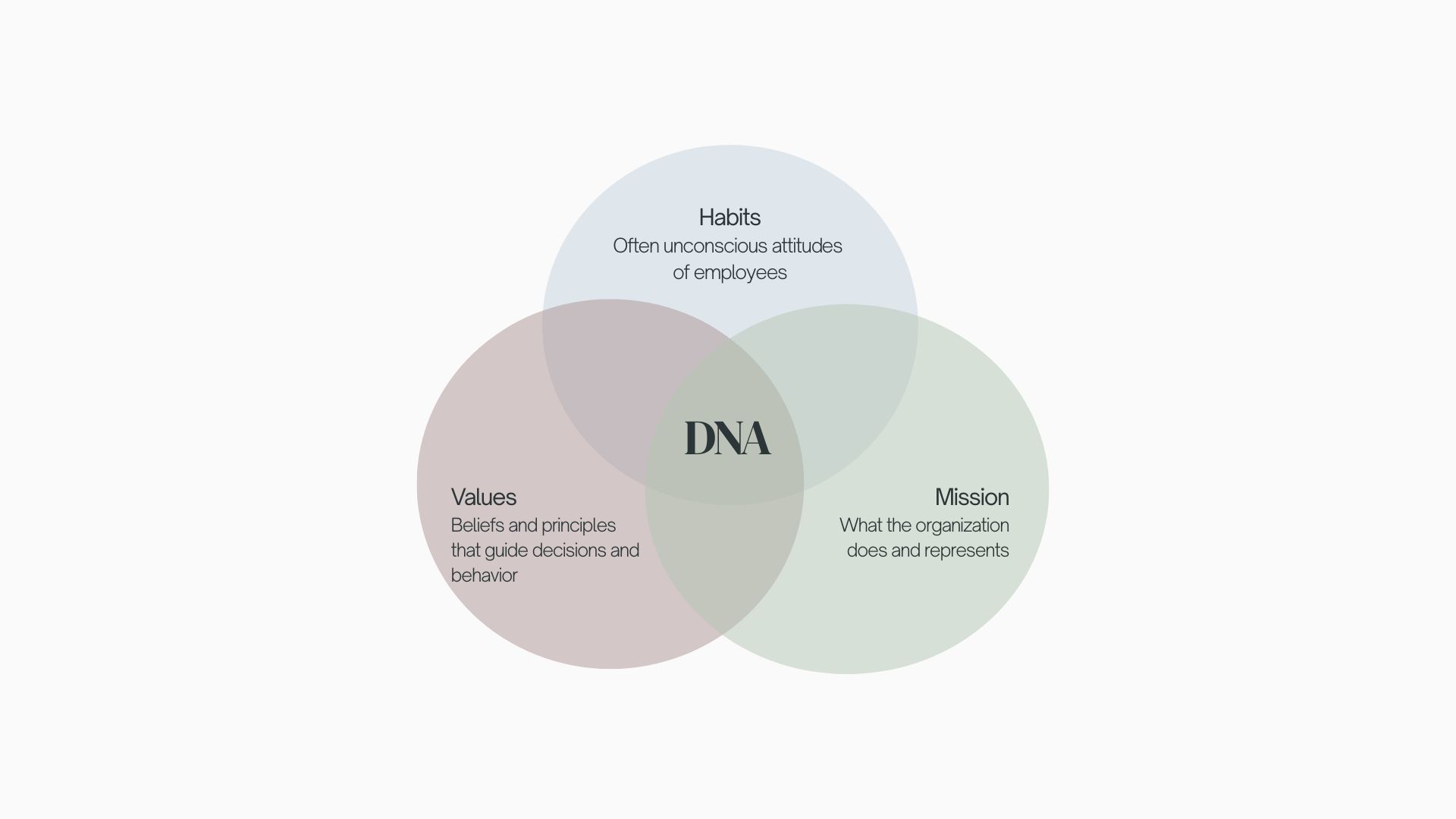
Before designing a space, you must understand the company itself. There are three essential components of its DNA:
1. Mission
Every company exists for a mission. This is what defines its purpose and its daily challenges.
2. Values
Values guide the decisions, principles, and beliefs that circulate internally. Two companies can share a mission without sharing the same values.
3. Habits
Habits play a significant role in space design. For example, if teams often gather around the coffee machine for 15 to 20 minutes, the layout can incorporate an internal coffee corner to support this practice.
The idea remains simple: the space should reflect the company’s DNA instead of contradicting it.
Consider the User Profiles
A company comprises several profiles, and each works differently depending on their daily tasks.
The Focused User
This profile needs concentration. They often work on tasks that require calm, attention, and few distractions.
The Connector
This profile needs to interact with others to progress in their work. They perform best when the space fosters proximity, quick discussions, and collaboration.
The Collaborator
This profile works within a team and needs easy access to colleagues to accomplish their tasks.
The Analytical User
This profile works more with data, figures, and information processing. They often need an environment conducive to concentration.
This perspective allows us to move beyond a generic approach. The idea is not to impose the same environment on everyone, but to understand who works how, and then design the space accordingly.
Integrating Neurodiversity into the Workplace
Neurodiversity is a non-medical, umbrella term for individuals whose brains function and process information differently from what society considers “typical” (neurotypical). There are various types of neurodiversity, including autism spectrum disorder, ADHD (Attention Deficit Hyperactivity Disorder), dyslexia, and other conditions.
Approximately 15 to 20% of the population is neurodivergent.
This implies an important reality: not everyone experiences the environment in the same way. Sensory processing exists on a continuum ranging from hyposensitivity to hypersensitivity, with each person occupying a unique position on this spectrum.
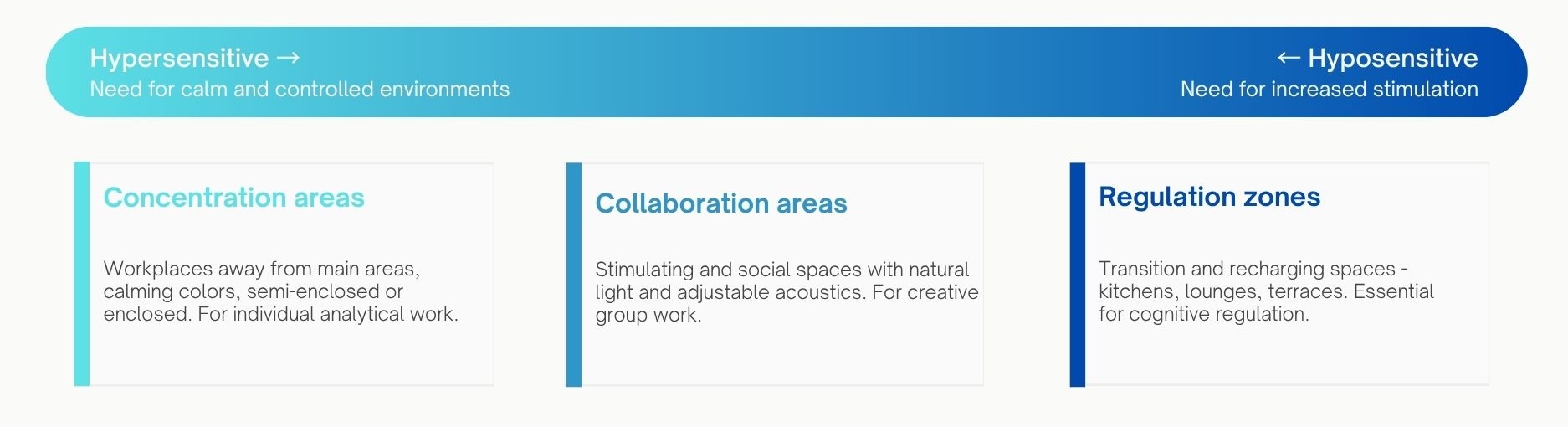
Hypersensitivity
In this case, the slightest distraction affects concentration. The space should therefore remain calm, controlled, and minimally stimulating.
Hyposensitivity
In this case, the person needs stimulation. Background noise, conversations, and activity in the space can help them concentrate and make progress.
An effective workspace design therefore offers:
- areas for concentration;
- areas for collaboration;
- more dynamic areas;
- recharge areas.
Among the charging areas, it is important to include:
- wellness rooms;
- relaxation areas;
- meditation spaces;
- possibly a gym within the office
Understanding Organizational Cultures
The workspace also reflects organizational culture. In 1983, academics Robert Quinn and John Rohrbaugh identified two major dimensions that allow for the categorization of organizational cultures. These dimensions form the basis of the Competing Values Framework (CVF)—a globally used model that has demonstrated the link between the type of work culture and organizational effectiveness.
The CVF is particularly useful for designing spaces, as each cultural quadrant generates different and distinct spatial needs.
An organization that chooses the wrong type of space in relation to its culture creates ongoing friction between the environment and expected behaviors.
Dimension 1: Flexibility vs. Stability
Focus on order and control (predictable and structured operations) versus adaptation and flexibility (dynamic and organic processes).
Dimension 2: Internal vs. External
Differentiates between an internal orientation (integration and maintenance of the internal environment) and an external focus (interaction with the market, competitors, and external stakeholders).
These two dimensions give rise to four distinct cultures.
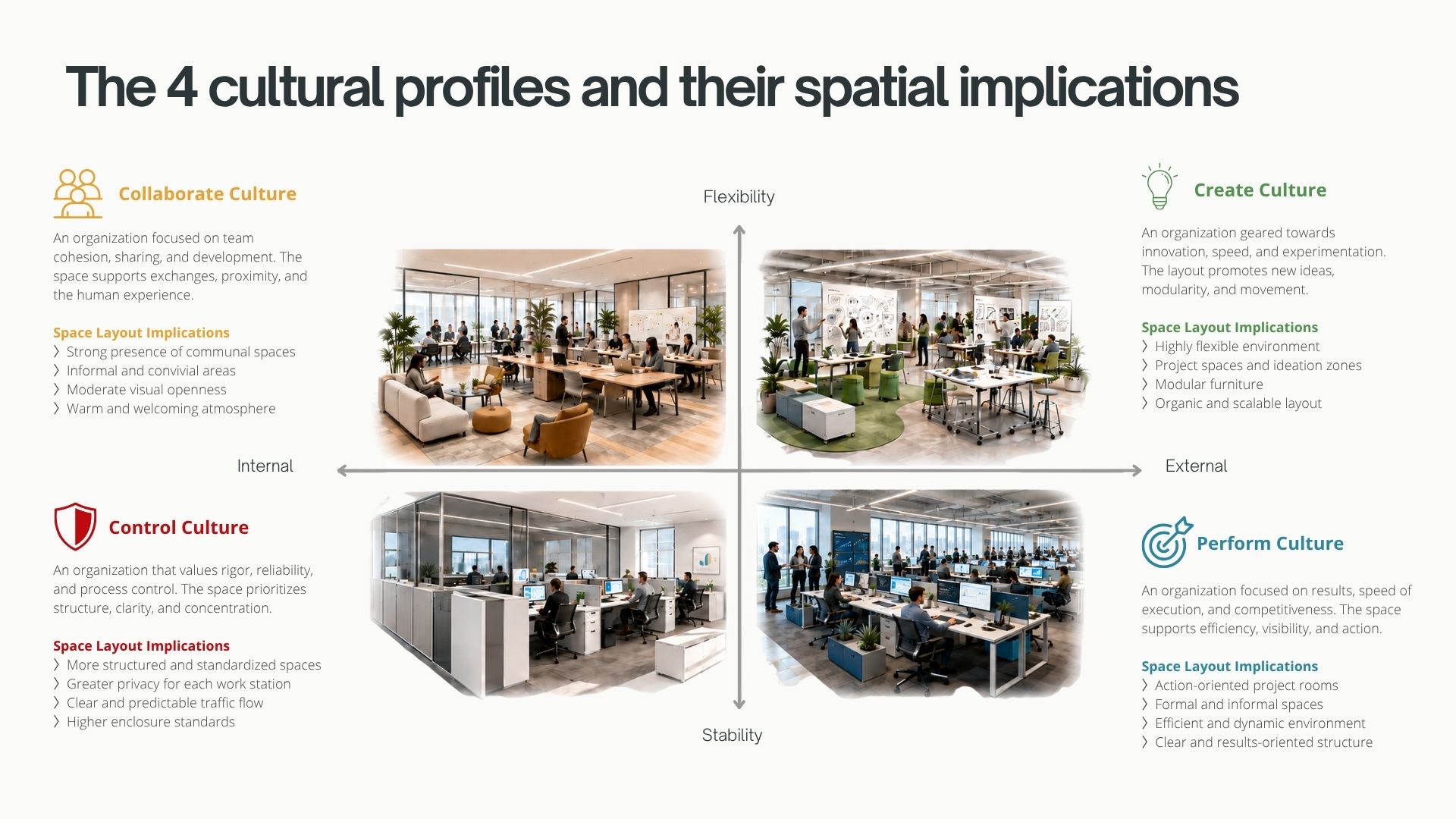
Collaborative Culture
This culture fosters interaction, exchange, and close relationships between teams. It often includes:
- large common areas;
- co-creation zones;
- lounges;
- connected workstations.
Creative Culture
This culture emphasizes ideation, creativity, and idea generation. The space is designed to support this with:
- mobile furniture;
- whiteboards;
- display surfaces;
- open areas for brainstorming.
Performance Culture
This culture focuses on efficiency, productivity, and speed of execution. Workspaces remain visible, dynamic, and oriented towards shared objectives.
Control Culture
This culture primarily concerns the management of sensitive information. It requires more compartmentalization, improved acoustics, and greater confidentiality.
These cultures are not mutually exclusive. A company can combine several approaches depending on its teams, departments, and practices. Organizations always have a dominant culture, but they also contain numerous subcultures within each team.
This is why a single spatial design cannot meet all needs. Understanding these micro-cultures is essential for designing differentiated and relevant spaces.
Organizing Space into Complementary Zones
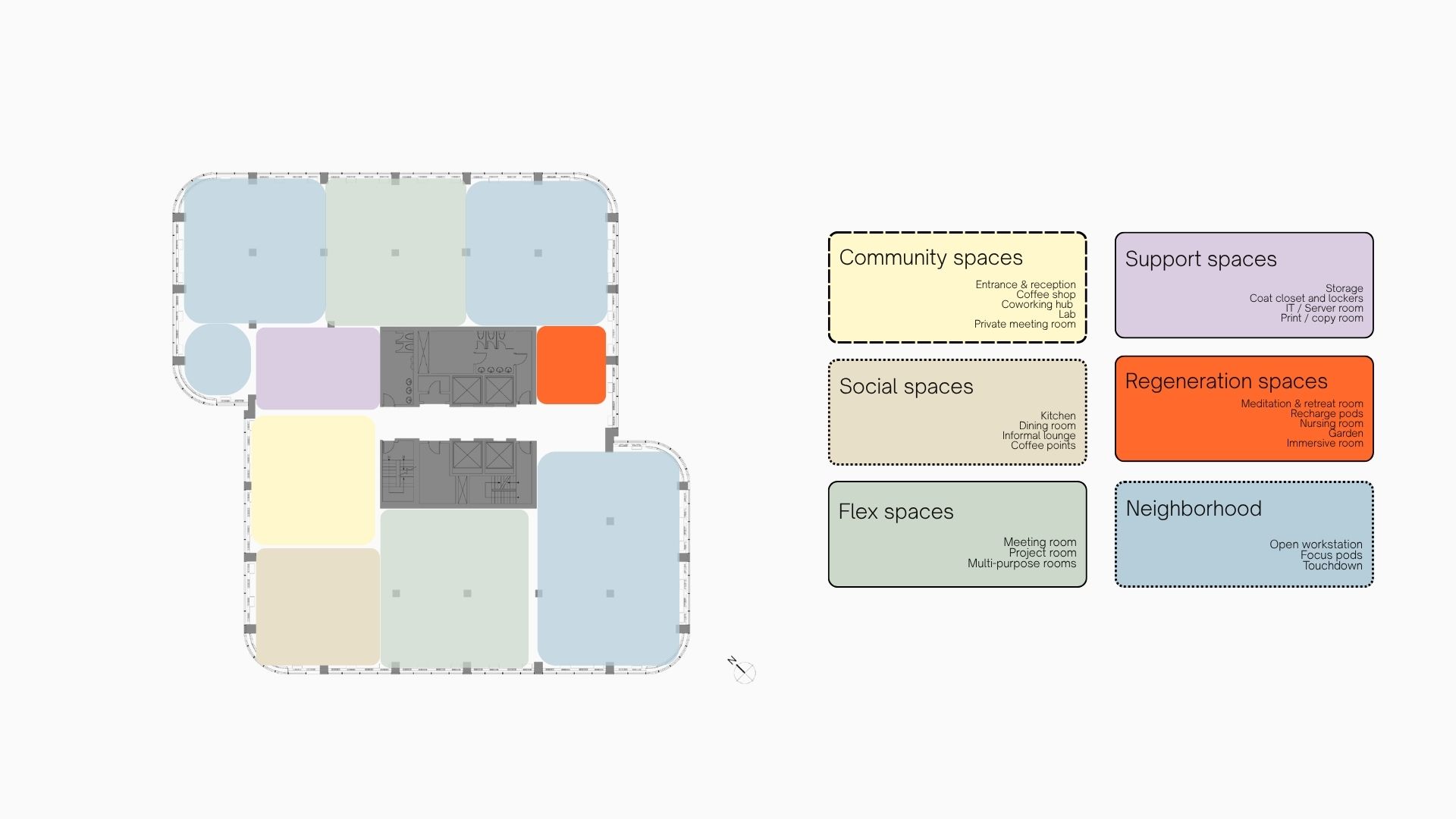
Office layout gains coherence when it is organized into several zones.
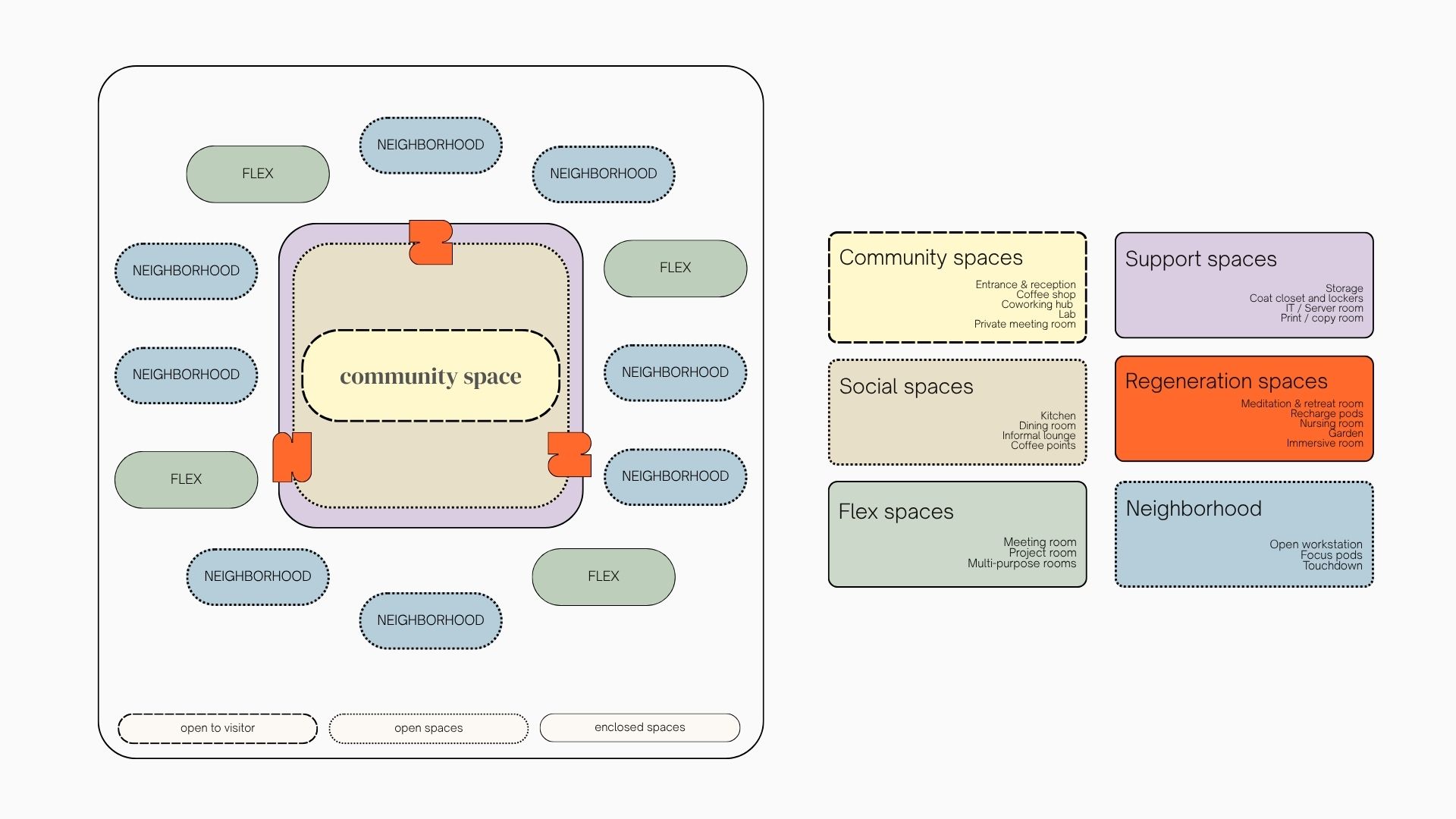
The Community Space
This area encompasses the entrance, cafeteria, and gathering spaces. It’s often where the organization’s culture, values, and mission are most strongly felt.
Social Spaces
These revolve around the community space and create a buffer between the office center and the work areas. They foster informal exchanges and connections between teams.
Support Spaces
These include, for example, storage areas, changing rooms, and support functions. They also create a useful sound barrier between open-plan spaces and work areas.
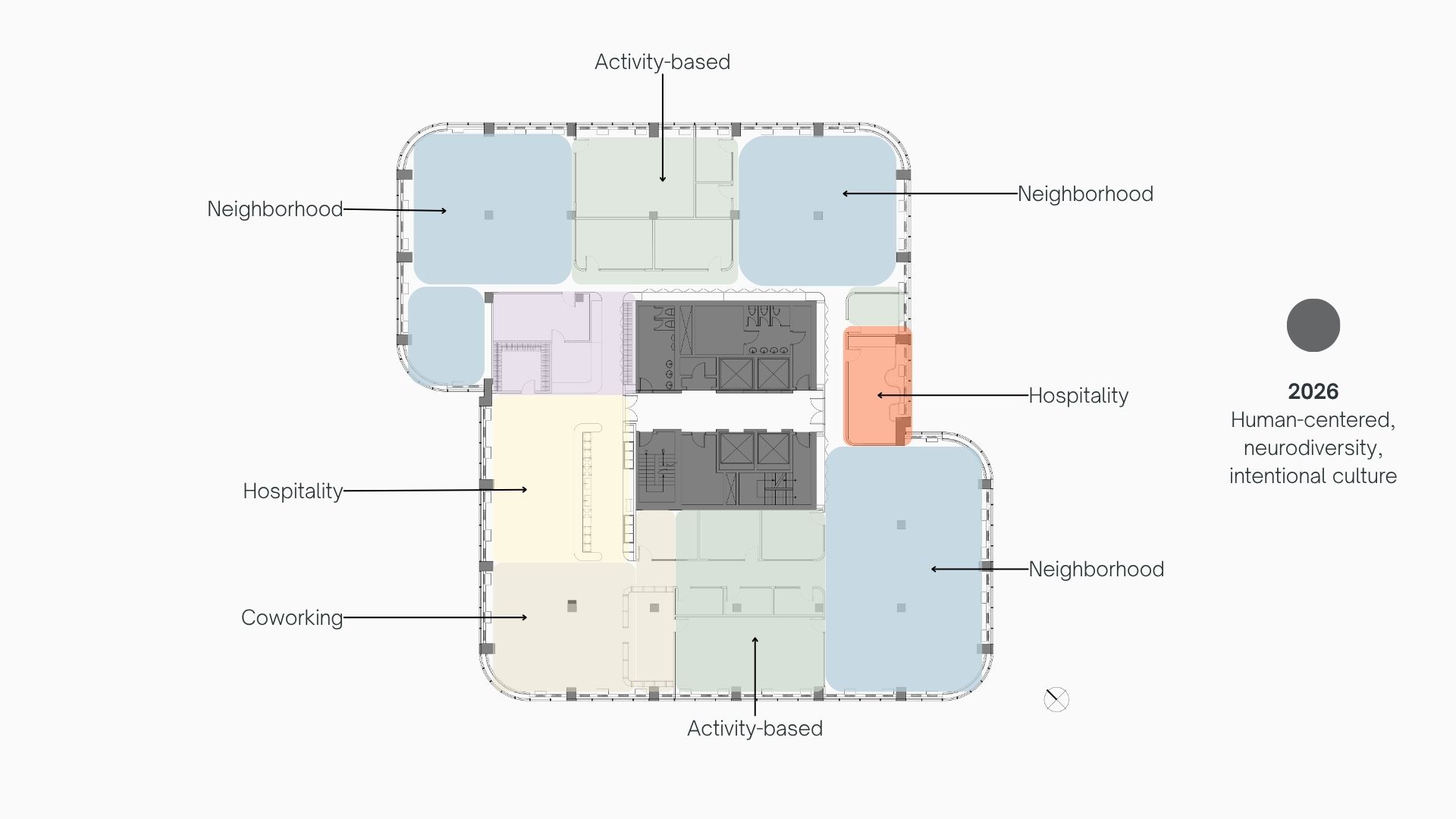
Neighborhoods
The source uses the concept of “neighborhood” to design spaces dedicated to a team. This approach strengthens the sense of belonging and provides a sense of structure in daily life.
Flexible Spaces
These accommodate collaborative activities in enclosed or modular spaces:
- Meeting rooms;
- Training rooms;
- Multifunctional rooms;
- Focus areas;
- Presentation spaces
Activity-Based Working Approach
Connecting spaces to daily activities. Five main activities emerge:
- PRESENTING
- IDEATING
- FOCUSING
- EXCHANGE
- PRODUCING
This approach allows the space to be adapted to actual needs:
A presentation room for meetings and training sessions;
- ideation areas for brainstorming;
- quiet spaces for concentration;
- informal discussion areas;
- production areas for individual or group work.
The goal is not to impose rigid uses, but to provide spaces that can evolve with the company.
Designing Flexible, Scalable, and Adaptable Offices
A flexible office functions like a set of modules that can be reconfigured over time. If the company grows, pivots, or changes its activities, the space must adapt. For example:
- replacing a lounge with a work area;
- transforming a meeting room into a more enclosed space;
- maintaining certain uses for one team and modifying others for another;
- varying the furniture to create different rhythms.
This approach makes the layout plan more sustainable and useful in the long term.
Evolving the Office with the Times
Office evolution often follows the trends that precede it.
- Large open-plan layouts create too much noise and chaos;
- cubicles then appear to better partition spaces;
- activity-based work brings greater mobility;
- office districts meet the need for familiar surroundings and a sense of belonging;
- hospitality transforms the office into a destination;
- a human-centered approach is essential in the post-pandemic context.
In 2026, the challenge will therefore be to combine the achievements of each era without being confined to a single trend.
The approach becomes more selective: we choose what truly serves the company, the teams, and the individuals.
Successfully Designing an Office Space in 3 Key Steps
To successfully design an office space, three steps must be followed:
1) Zoning the Space
First, define the different areas and the overall structure of the floor plan.
2) Designing Organizational Cultures
Next, connect the space to the company, the teams, and the individuals.
3) Creating Designed Zones
Finally, translate all of this into activities, furniture and uses.
This approach is most effective when based on co-creation. Teams participate, give their opinions, and contribute to choosing the solutions that best suit their needs.
Why this approach improves talent engagement
When a space respects actual usage patterns, it strengthens the sense of autonomy. When it offers choices, it helps everyone perform better. When it reflects the organization’s identity, it fosters a sense of belonging.
The best organizations strive to create:
- an inclusive environment;
- ergonomic and wellness-oriented spaces;
- good lighting;
- greenery;
- appropriate furniture;
- social rituals;
- places that people want to return to.
In summary
Designing offices that attract, engage, and retain talent requires much more than aesthetics. It’s essential to understand:
- the company’s DNA;
- user profiles;
- neurodiversity;
- organizational cultures;
- complementary zones;
- evolving usage patterns;
- daily activities
A high-performing workspace doesn’t seek to impose a single model. Rather, it creates a flexible, coherent, and human-centered framework capable of supporting individuals, teams, and the organization as a whole.
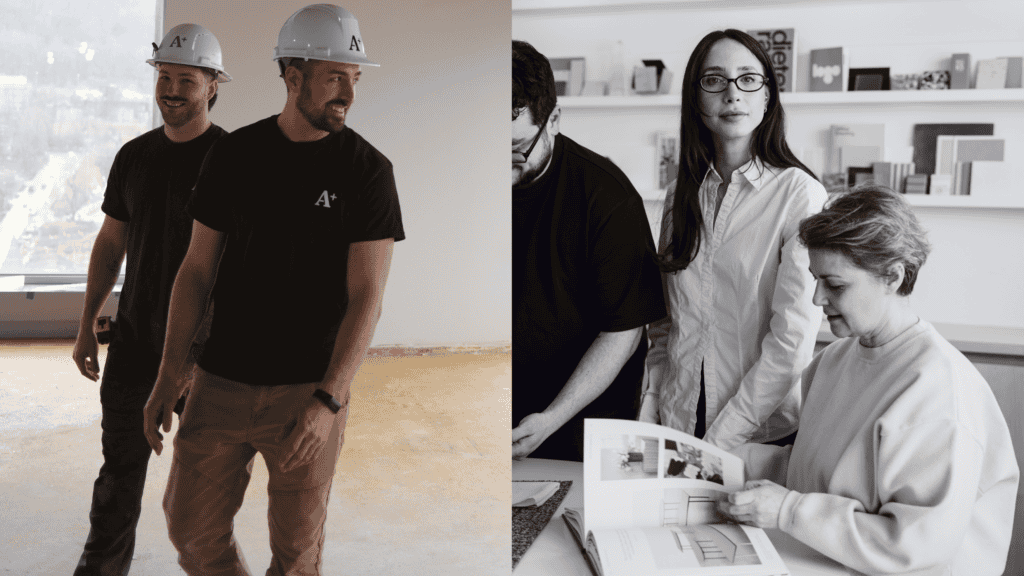
As an integrated project management firm, A+ supports companies in the design, construction, and management of their office fit-out projects. A+’s integrated approach begins with a thorough assessment of your organizational culture: Who are you today? Who do you aspire to be? What subcultures coexist within your teams? This strategic diagnosis is the foundation upon which A+ builds.
By aligning workspaces with culture, collaboration methods, and business objectives, A+ helps you create high-performing, engaging, and sustainable environments.
Tell us about your project!
Do you have a real estate project in mind, but don’t know where to start? We can help! Contact us now to learn more about our services and discuss your project!